
Road Trip to the End of the World, developed by
Shark and Pelican Games, is a compact visual novel about the slow, aching death of a long friendship. You play as Andy Min, a 23-year-old who is having the worst summer of her life. She dropped out of med school and wasn’t invited to her ex-best friend Bora’s wedding. So naturally, instead of confronting her feelings, she packs up, hits the road, and drives all the way to California to crash the wedding and get some closure. Whether Bora wants that or not.
And her childhood imaginary fish friend Fishy is coming too. Somehow.

Shark and Pelican Games
A Story About Friendship, Guilt, and Fishy
Andy and Bora were best friends for 14 years, and the game understands that relationships with that much history don’t end cleanly. Rather than laying everything out immediately, Road Trip slowly unravels what happened between them over the course of the drive, letting conversations and memories fill in the gaps.
What works especially well is how the game handles accountability. Andy wants forgiveness, but she also wants to justify herself, to be understood, maybe even to undo the damage entirely. The writing gives her room to be stubborn, selfish, funny, and deeply human without sanding off her rough edges.

Shark and Pelican Games
Fishy ends up being an important counterbalance to all of that. Imagined when the girls were 10 years old as a way to cope with the death of Andy’s pet fish, Fishy carries the kind of childlike optimism and excitable energy that feels frozen in time. She dreams about having adventures of her own and approaches the world with a wide-eyed sincerity that contrasts sharply with Andy’s emotional exhaustion. In a lot of ways, both characters are trapped in the past, just differently: Fishy wants to grow up and move forward, while Andy is still trying to return to a version of her life where things with Bora hadn’t fallen apart yet.
For a game that lasts only a couple of hours, it lands its emotional beats with surprising restraint. By the end, Andy’s gradual attempt to let go – of Bora, her guilt, and eventually Fishy – carries real weight.
Gorgeous Visuals and a Vibe That Carries You
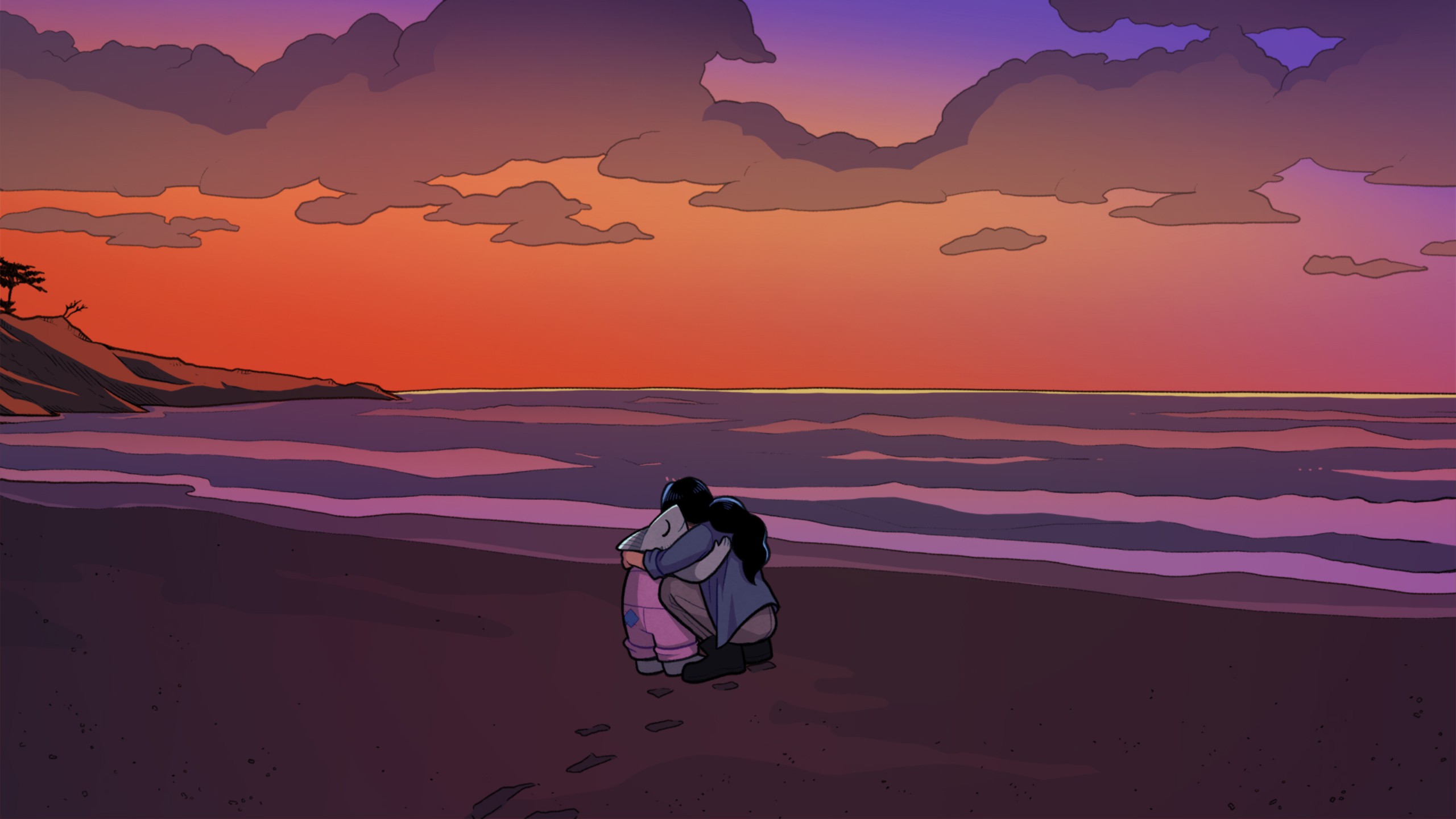
The art in Road Trip is one of the game’s strongest qualities. Sweeping scenic shots are rendered in warm, vibrant colors that give the cross-country drive a real sense of atmosphere, while the interactive scenes are filled with small details that make each stop feel lived-in.

Shark and Pelican Games
The gentle, soothing soundtrack is equally strong – a perfect companion to long stretches of highway introspection. It never gets in the way and often elevates moments that might otherwise rely too heavily on the dialogue alone.
Minimal Gameplay, and It Shows
The gameplay is where Road Trip runs into some limitations. The gameplay is about as light as it gets. And unlike many visual novels that use player decisions to create meaningful branching paths, this one doesn’t really. There’s one ending. Your choices shift the texture of the conversation rather than its destination.

Shark and Pelican Games
For some players, that’s completely fine – a linear narrative experience with a strong emotional through line is its own valid form. But when the most consequential choice you make is which burger Fishy gets excited about, the interactivity starts to feel more like window dressing than an actual layer of the experience.
A Brief But Effective Narrative Experience
Road Trip to the End of the World is a small, focused narrative game that understands exactly what it wants to do. In a short runtime, it explores fractured friendships and unresolved guilt with a surprising amount of restraint, helped along by strong visuals and an excellent sense of atmosphere.
Fishy, despite the absurd premise, ends up giving the story much of its warmth. The game’s biggest weakness is its limited interactivity, but if you’re into visual novels, there’s a lot to appreciate here.



Leave a Reply